
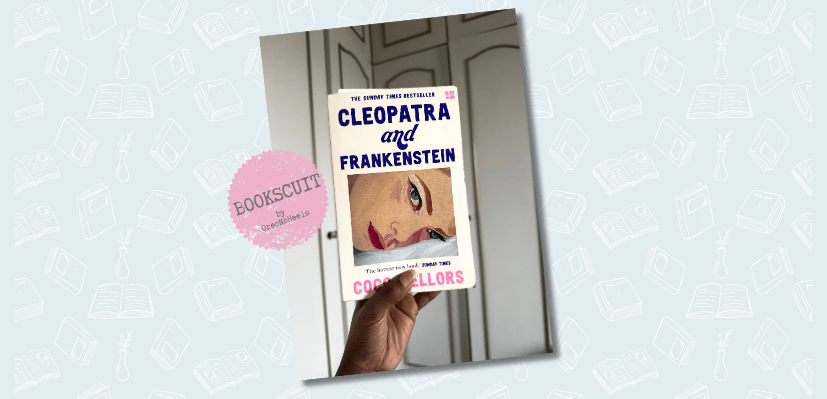
Books that live rent free in my head – series. #1
What is the true meaning of love and marriage? That is the ultimate research of all art has been trying to explore without ever finding an absolute answer (and maybe that’s the whole point). Cleopatra and Frankenstein has explored it in the most raw reading experience I’ve ever had.
/!\ Spoilers ahead. /!\
It is not a dark romance, but it’s a romance and it gets dark. Cleopatra and Frankenstein follows the tumultuous love story between Cleo, a 25 years-old British student with an expired visa and Frank, a successful 40 something years-old American advertising genius with a matching sense of fun. Their connection was direct and the book captured it in the first sentence. And their love was, despite the marriage in the rush, real.
Through out the book, Coco Mellors unfolds a love story that starts fun, light and sexy but slowly gets tainted by too much fun and too much alcohol. The tool that abuse of substance take on Frank (who abuses it) and Cleo who’s only trying to fit into her own life is terrible. Throughout the entire book, you want to root for Cleo, who wishes for Frank to stop drinking and be the husband she hoped and knew he could be. Until you meet Eleonore and the dynamic she presents.
The age gap between Cleo and Frank is not something that is directly spoken about in the book but is felt throughout. They both are at different stage of their life and are both very aware of it. You can tell that Frank fell in love with Cleo’s youth. When he meets her, she’s young, carefree, fresh and sexy. She loves and incites fun without judging and yet, has a very mature ways about her due the her early independence. Her love for art and creativity are also big parts of loving her. You can tell that Frank loves the fact that she is in that carefree stage of life and, through her, gets to stay young longer. As for Cleo, Frank is the most stable person in her life, the adult she has been missing. He had a stable job, was even rich, good at what he does, and yet, didn’t judge her and understood her. Through him, she felt seen, validated in her path and even encouraged to take the time to figure out who she is. And although both seems to be a match made in heaven, Cleo does grow up and Frank, doesn’t. At their peak, their mental age maybe matched but then, they crossed path and the gap grew again.
Things starts to get sour when they go on holiday in the South of France. You can sense Cleo’s aversion for Frank’s drinking habits. An aversion that, as drinker myself, I understand. That chapter was particularly anxious for me as I felt like Frank might die. To contextualize, he bet with another man they met at the hotel that he could jump from the balcony to the pool. Cleo was worried and didn’t comprehend how he could do something so dumb that she decides to leave. She ends up going to a party with teenagers younger than her, feeling sick of staying with old men. Turns out it wasn’t the best idea. Going back to New York didn’t make things better. Frank is either at work or drinking after work, coming home drunk. Cleo starts to feel lost in their marriage. She doesn’t understand him anymore and neither does he. You would think that bringing up his alcoholism would start a conversation, but it only starts conflict. Frank isn’t violent when he’s drunk, he is happy. It makes him fun unlike his mother who’s alcoholism made her a catastrophic mother. Because he’s not like her, he doesn’t view himself as an alcoholic and resents Cleo for even suggesting it. His entourage doesn’t seem as worried as she is, so she feels completely alone.
What makes it worse for Cleo, the only true friend she has is Quentin, a polish privileged boy she studied with who wished he had had a lavender wedding with Cleo. Despite not liking Frank and it being mutual, they love Cleo in the same toxic way. They both crave her carefree self and didn’t give a damn about her wellbeing. Both also resent her search for normalcy. In her spiral of depression, she seeks refuge in Anders, Frank’s best friend with whom she had had a one night stand with. Right off the bat, they start another affair. In him, she thinks she finally found somebody who loves her and would be the safety net of the depression she was drowning into. But even if he has love for her, Anders is aware of who she was: his best friend’s wife. He’s also aware of who is not: a husband. Throughout the book, you see every single person in Cleo’s life fail her, including herself. That spiral leads her to her tipping point where she tries to commit suicide. And although she survives, her marriage to Frank turns into dust at that moment.
I believe that Frank didn’t understand adulthood and simple love until he met Eleonore. Her introduction is such a disruption of the rest that Coco even writes her chapters in the first person unlike the rest of the novel. Her experience of Frank is so different of Cleo that it feels distant. They connect through their humor and an unspoken connection that, at first, feels so one sided in Eleonore’s side. Or at least that’s how she interprets it. But then everything aligns to the point that it is undeniable. On paper, they are the perfect slow burn. If you read only her chapters, you get a soft and carefully written love story that is so outside of Cleo’s and Frank’s. Cleo is a background character in it, barely an obstacle. She’s just the 20-something year old play thing that Frank married, not his actual wife, not someone he actually loved. Initially, you want them to remember her. And on personal level, even if I hated Frank, I wanted him to choose Cleo. Instead, after Cleo’s attempt, he got himself into rehab before entering a relationship with Eleonore. He slowly became the man Cleo needed him to be, but for someone else.
It kind felt like a defeat to me. But what I took from the book is that it didn’t end the way I wanted, but the way it was supposed to. Frank and Cleo’s marriage was toxic to both of them. Cleo’s depression put too much pressure on Frank’s poor mental stability. He didn’t have the maturity that she needed. And Cleo needed a healthier space to grow and New York wasn’t it. New York was Frank’s alcohol abuse, Anders’ immaturity, Quentin’s jealousy and hectic choices in life. She needed simple, she needed healthy. Moving to Italy to focus on her art was the perfect ending she truly deserved, not a man.
I did find this book perfect. It was hard to put away, captivating, and I felt everything the character felt. It will forever live rent-free in my head. Coco Mellors loves to write humans and love stories as they are and not the polished version of them. It feels very chaotic, sometimes triggering, but ultimately hopeful and beautiful.
 OREONOHEELS
Leave a comment